A walkthrough of the brain and nerve cord connectome
This is a blogpost version of my BlueSky thread, and I will link out to collaborators on BlueSky to help you find them!
A full CNS connectome
The BANC is a full central nervous system (CNS) connectome of a limbed animal at single-synapse resolution, letting us follow sensory-motor arcs and understand how the CNS controls the body. Read it in Nature: rdcu.be/fncjS. Animation by Tyler Sloan.
A short history of connectomes
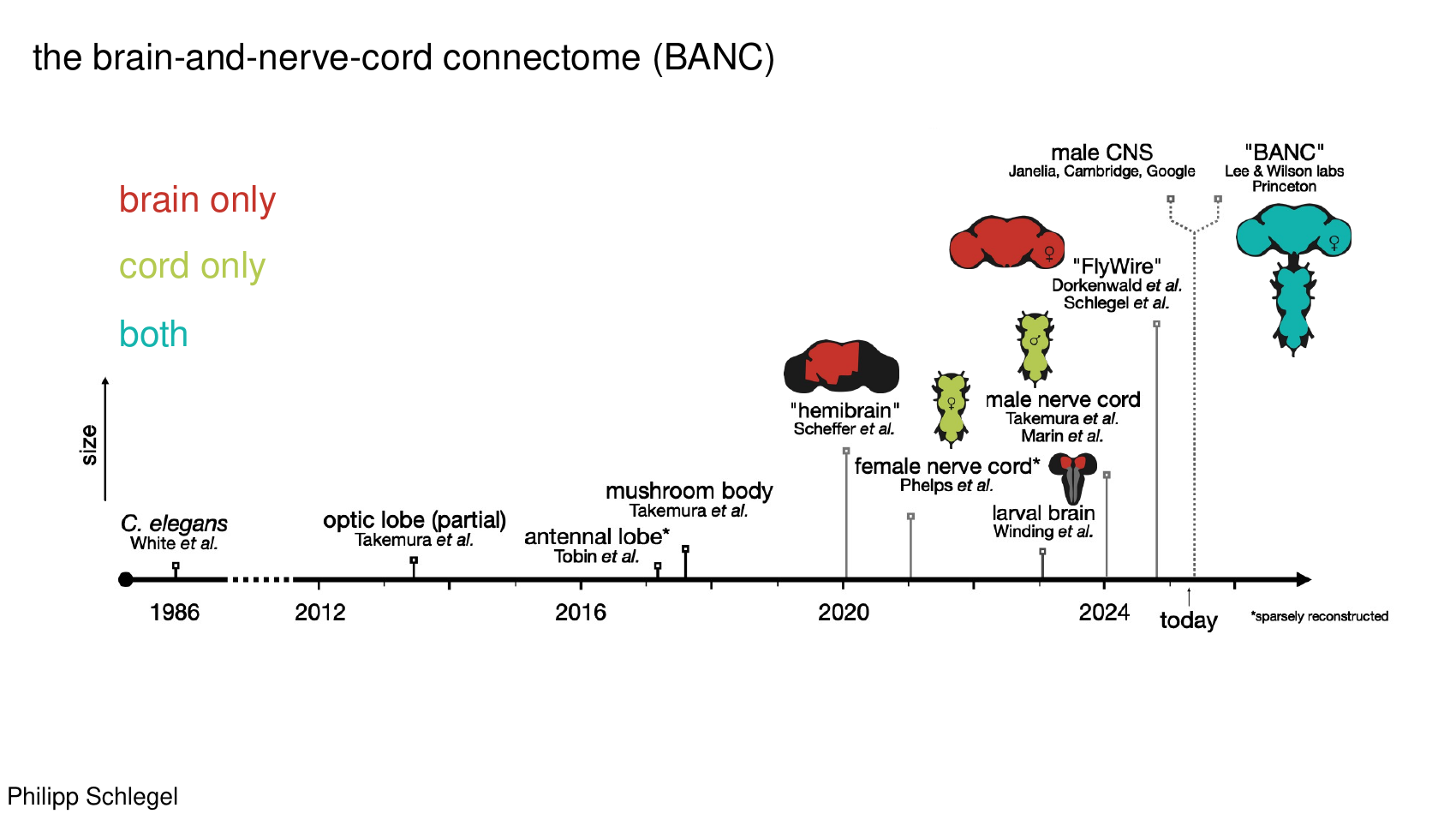
Connectomes are accelerating, from the ~300 neurons of C. elegans forty years ago to the fly brain (FAFB). The BANC is the next big step: a full CNS, brain and nerve cord together, a powerful hypothesis-generation engine.
How it was built, and proofread
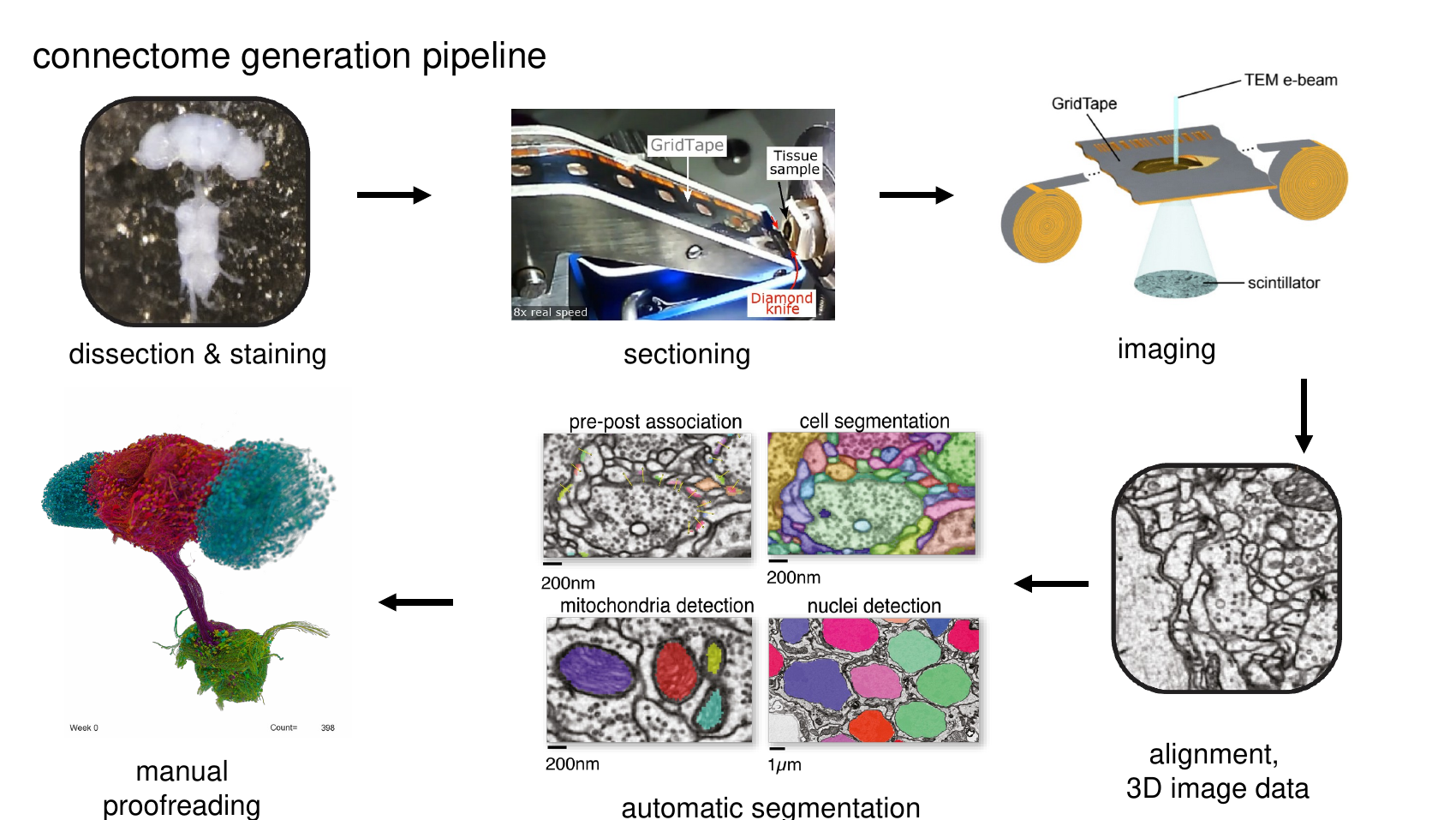
One adult female fly: dissected, cut into 7,010 slices, EM-imaged, aligned to 3D (Minsu Kim, Jasper Phelps). Neural nets (Zetta AI) segmented cells, synapses and transmitters; the SixEleven and Aelysia teams proofread over about 3.5 years (animation by Sven Dorkenwald).
Cell typing and classification
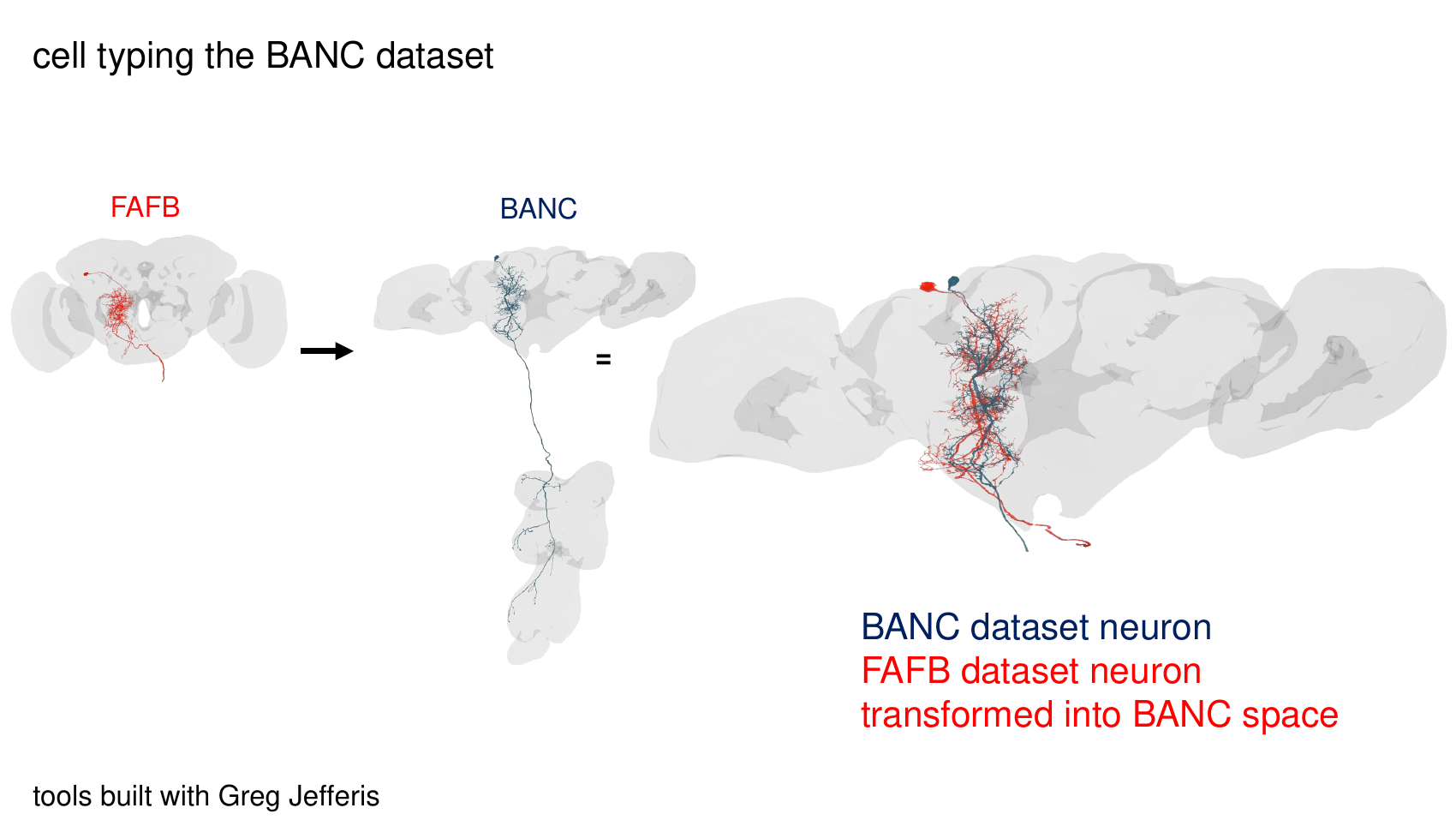
We linked the BANC to other connectomes mainly by morphology: the steering neuron DNa02 matches closely between FAFB and the BANC (tools developed with Greg Jefferis). With Helen Yang we refined classification into literature-consistent groupings, with detailed metadata.
An embodied connectome
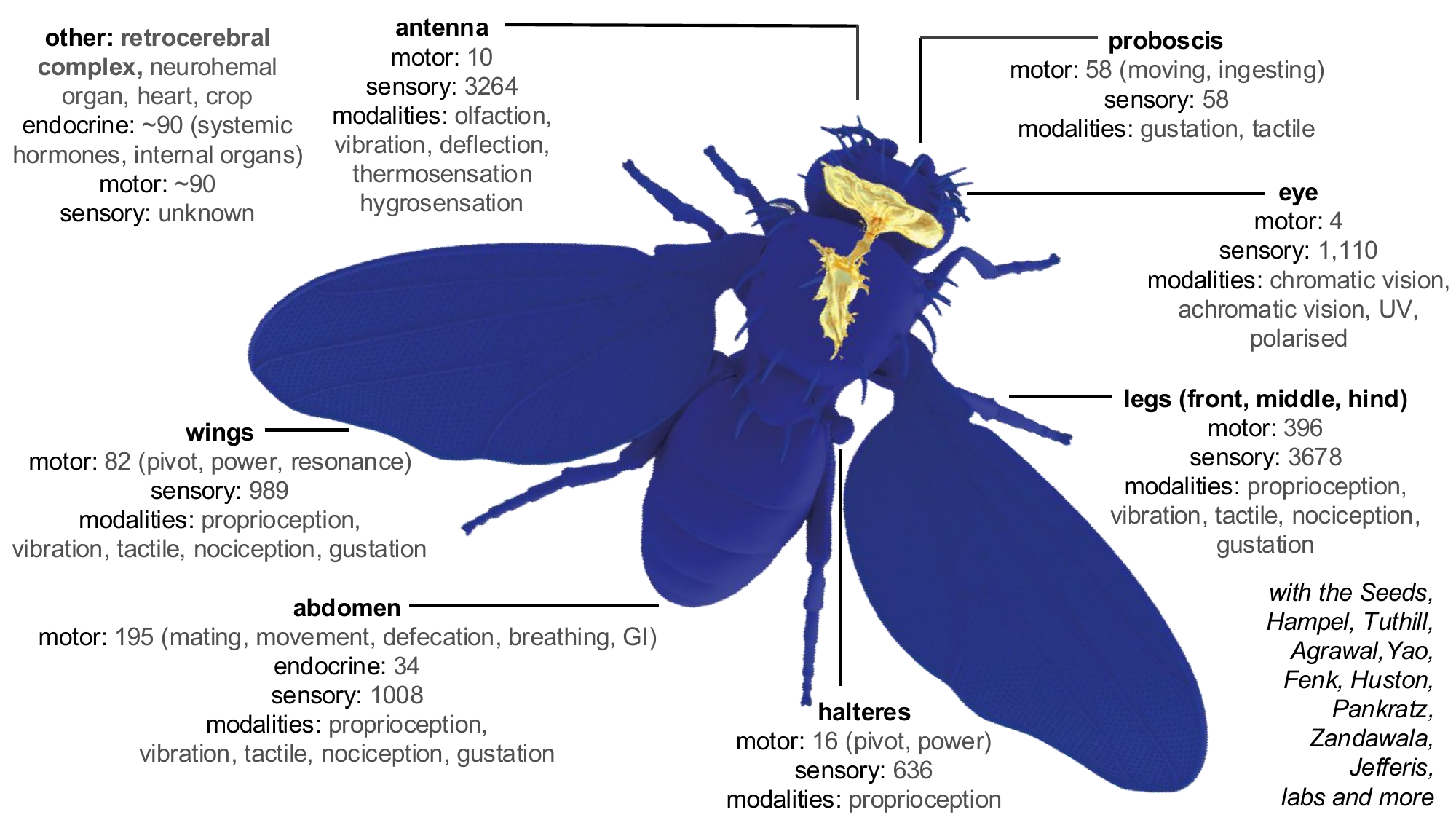
We saw a chance to build an “embodied” connectome, one that links sensors and effectors across the body to the CNS. These peripheral labels are among the most interpretable we have.
Reading 160,000 neurons with influence
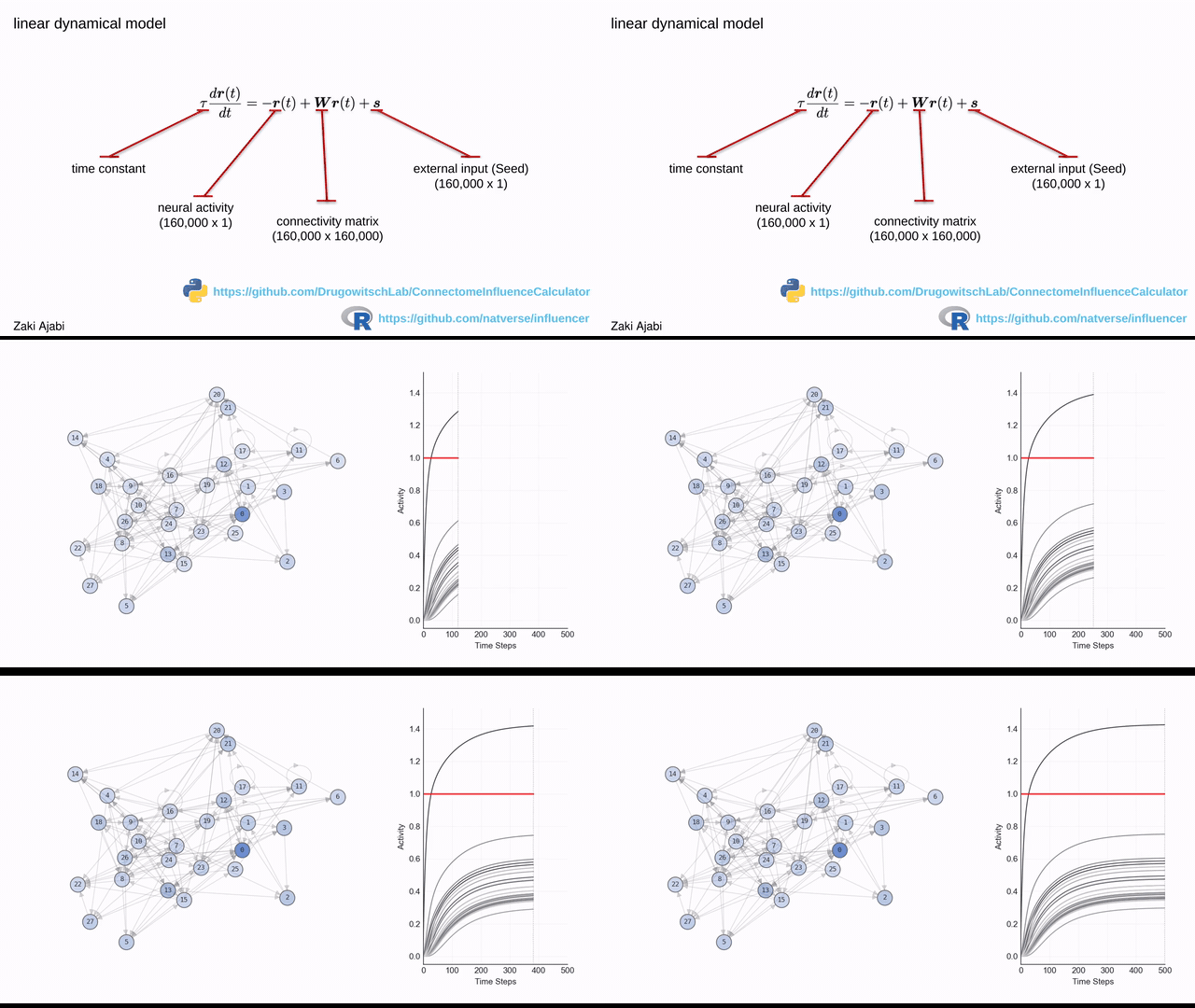
How do you read 160,000 neurons when most connections are indirect? Linear dynamics. Influence (with Zaki Ajabi) estimates how strongly one neuron affects another across the entire network: a scalable measure of network distance. Code: zenodo.org/records/15999930.
Control built from local loops
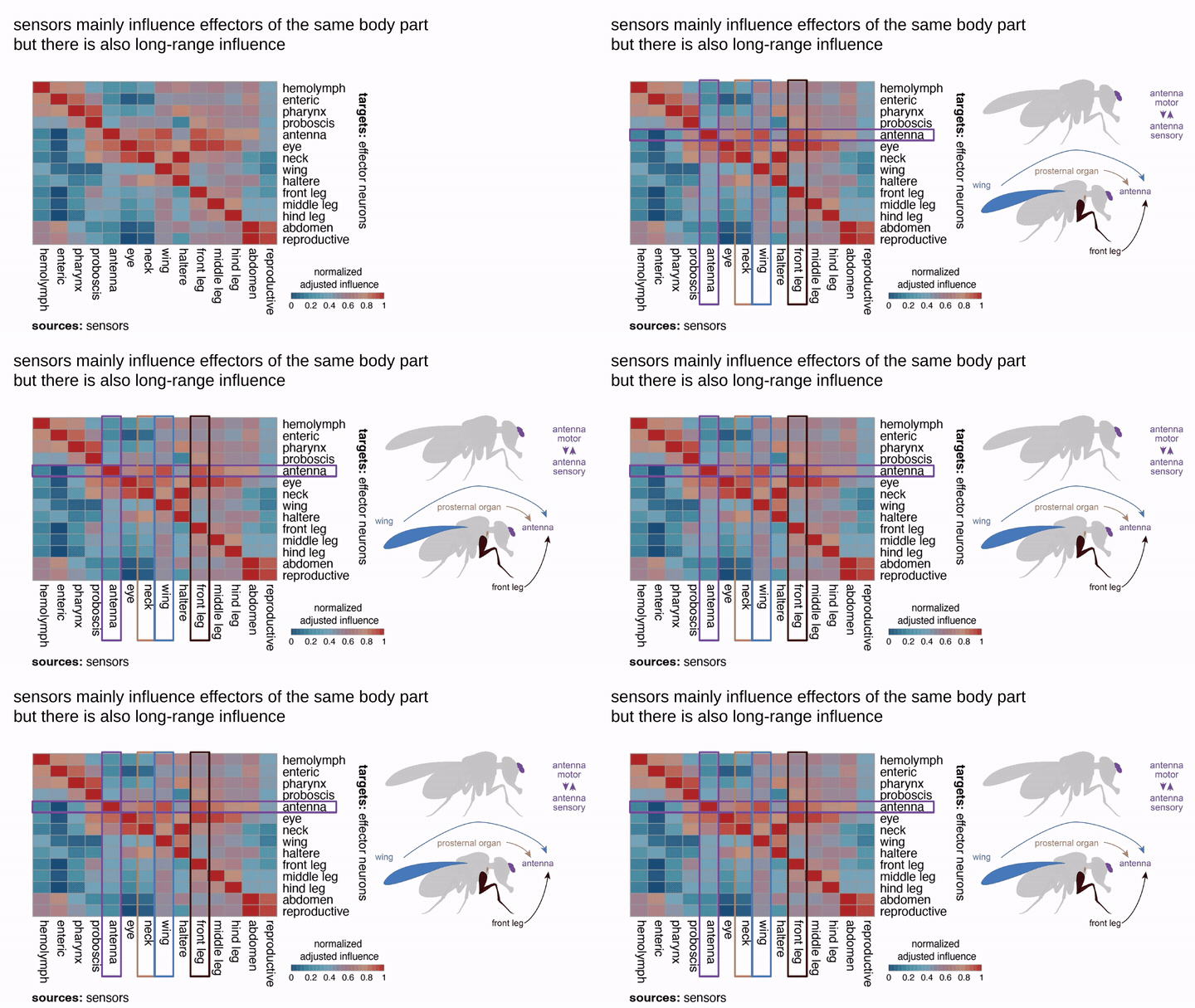
Following influence from sensors to effectors, body part by body part, reveals control built from local sensorimotor loops. Effectors are influenced most by their own body part’s sensors (the diagonal); weaker off-diagonal links join body parts, key for complex behaviour.
The neck
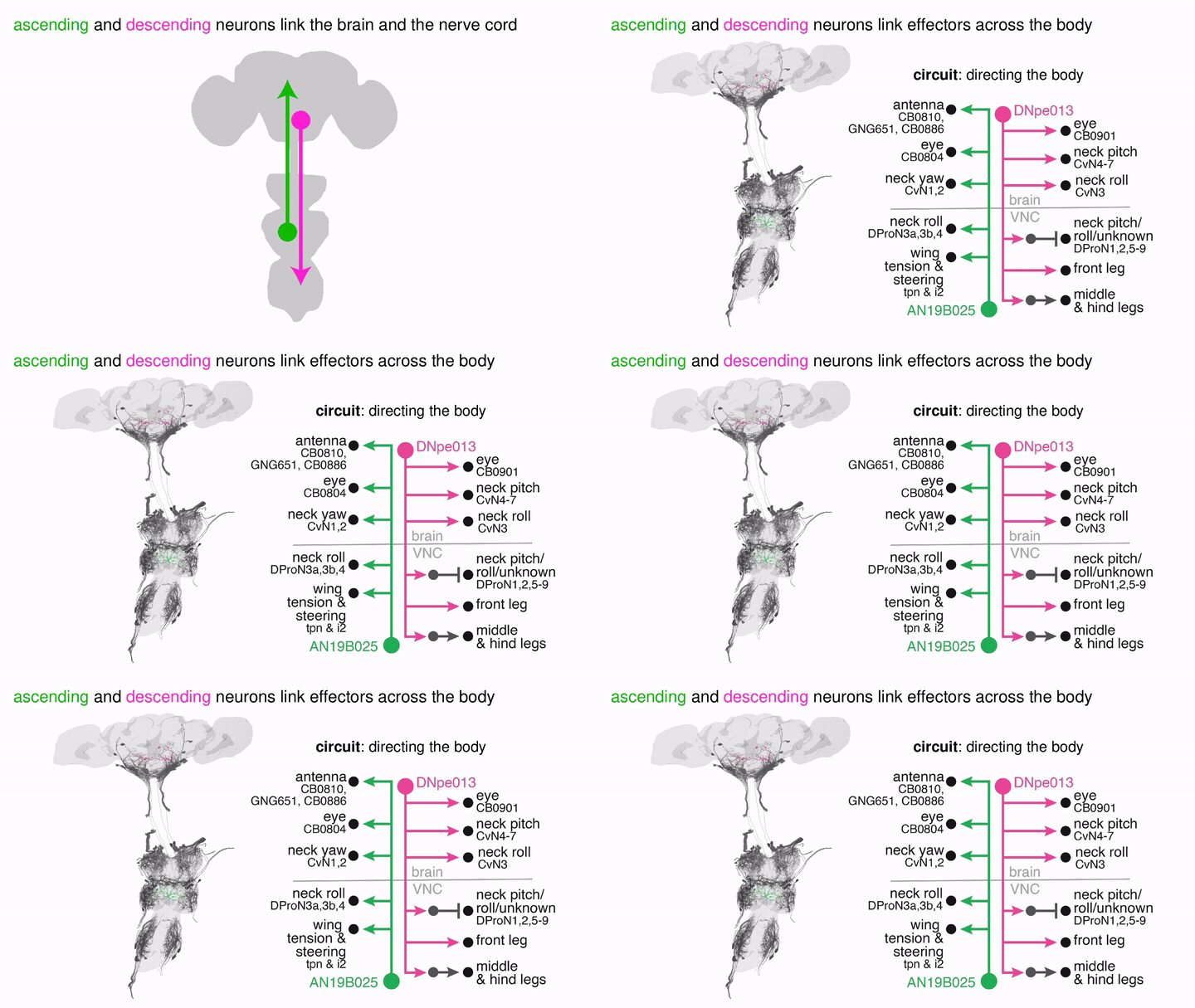
Where are the long-range links that join these local modules? Easiest to find at the neck, because these are definitionally long-ranged and cross module. About 3,600 ascending and descending neurons cross it, wiring the brain to the nerve cord, and one body part to another.
A map of the long-range neurons
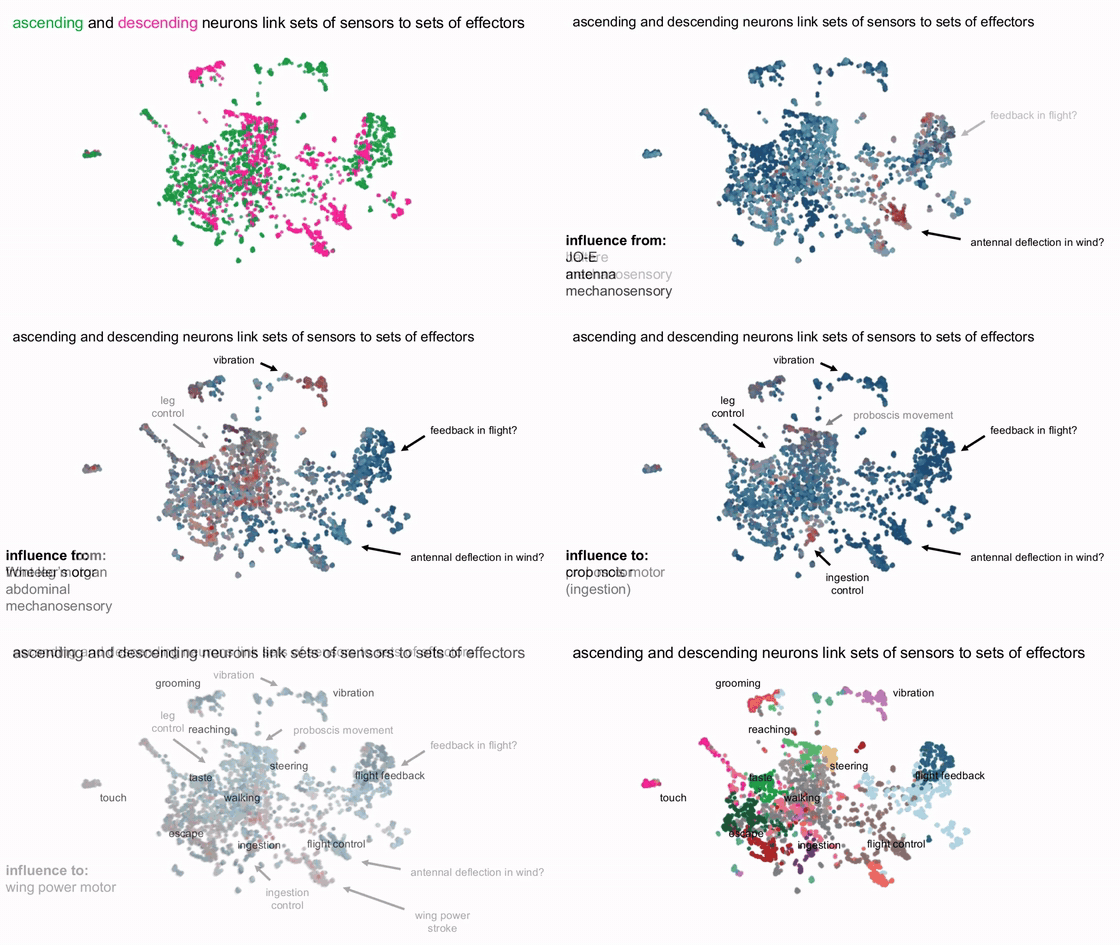
We embedded the neck neurons by connectivity, then lit the map up by influence from each sensor and to each effector. They resolve into clusters that, we infer, group controllers by behaviour: walking, flight, grooming, feeding, reproduction, threat and more.
A vignette: flight power
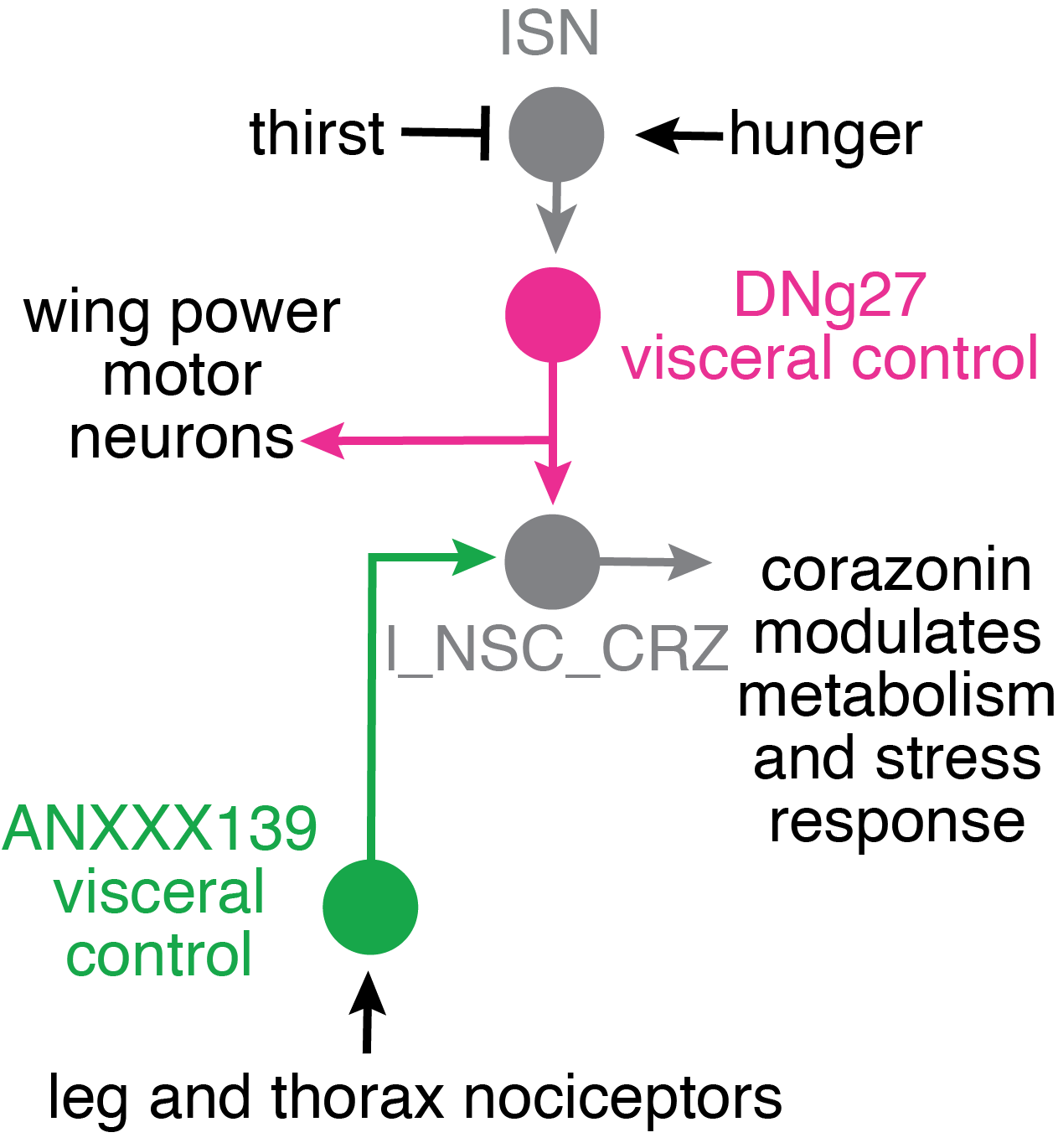
Let’s look at a specific example. DNg27 drives flight power and, at the same time, recruits the endocrine cells that release the energy flight demands. One cell, matching a behaviour to the body state that supports it.
A heterarchy, not a hierarchy
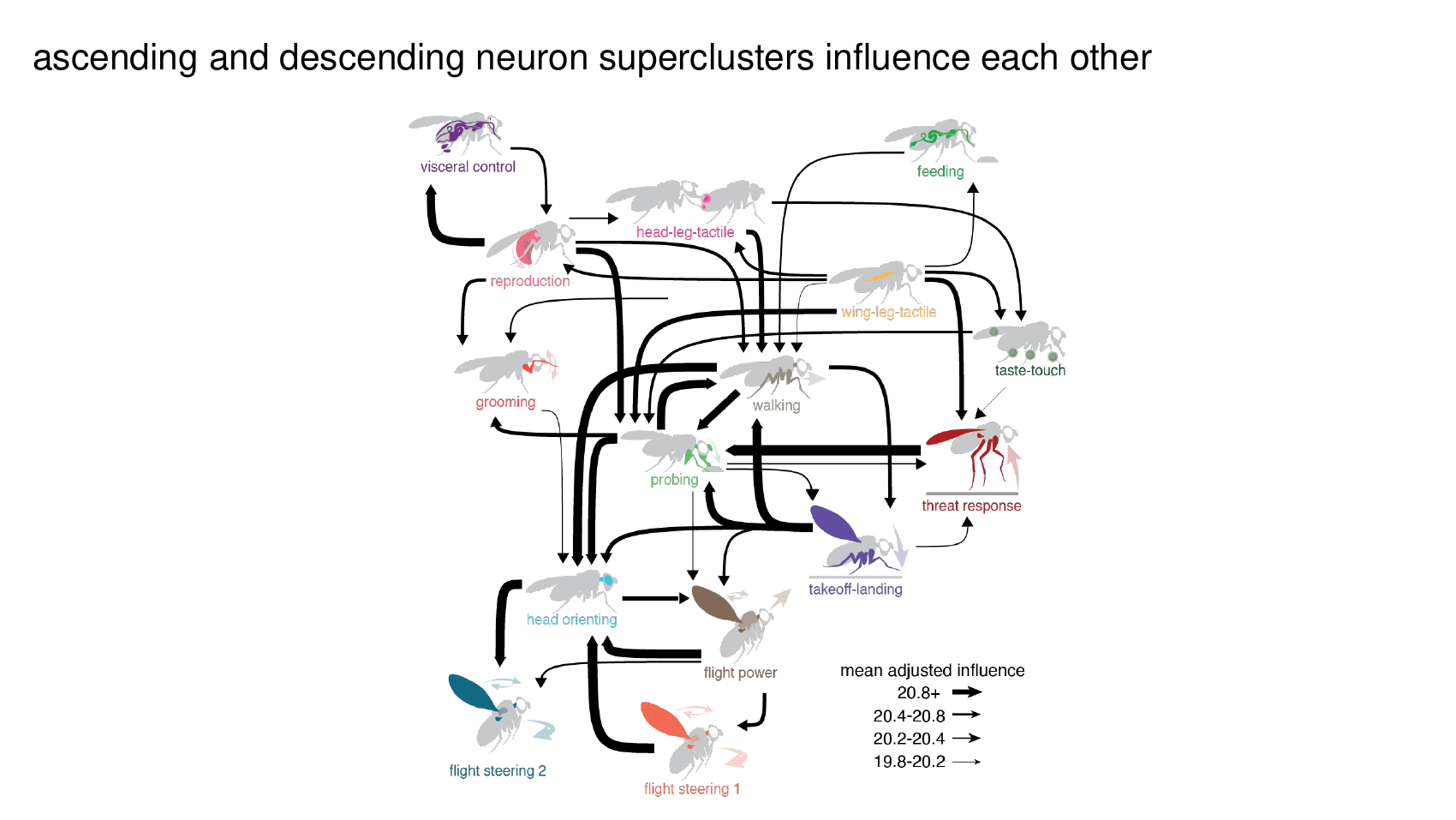
The modules influence one another, forming a heterarchy rather than a strict hierarchy, where they recruit or suppress each other. Together it resembles Rodney Brooks’ subsumption architecture from robotics, where complex behaviour comes from layered, semi-autonomous modules with no central controller.
A deep, open resource
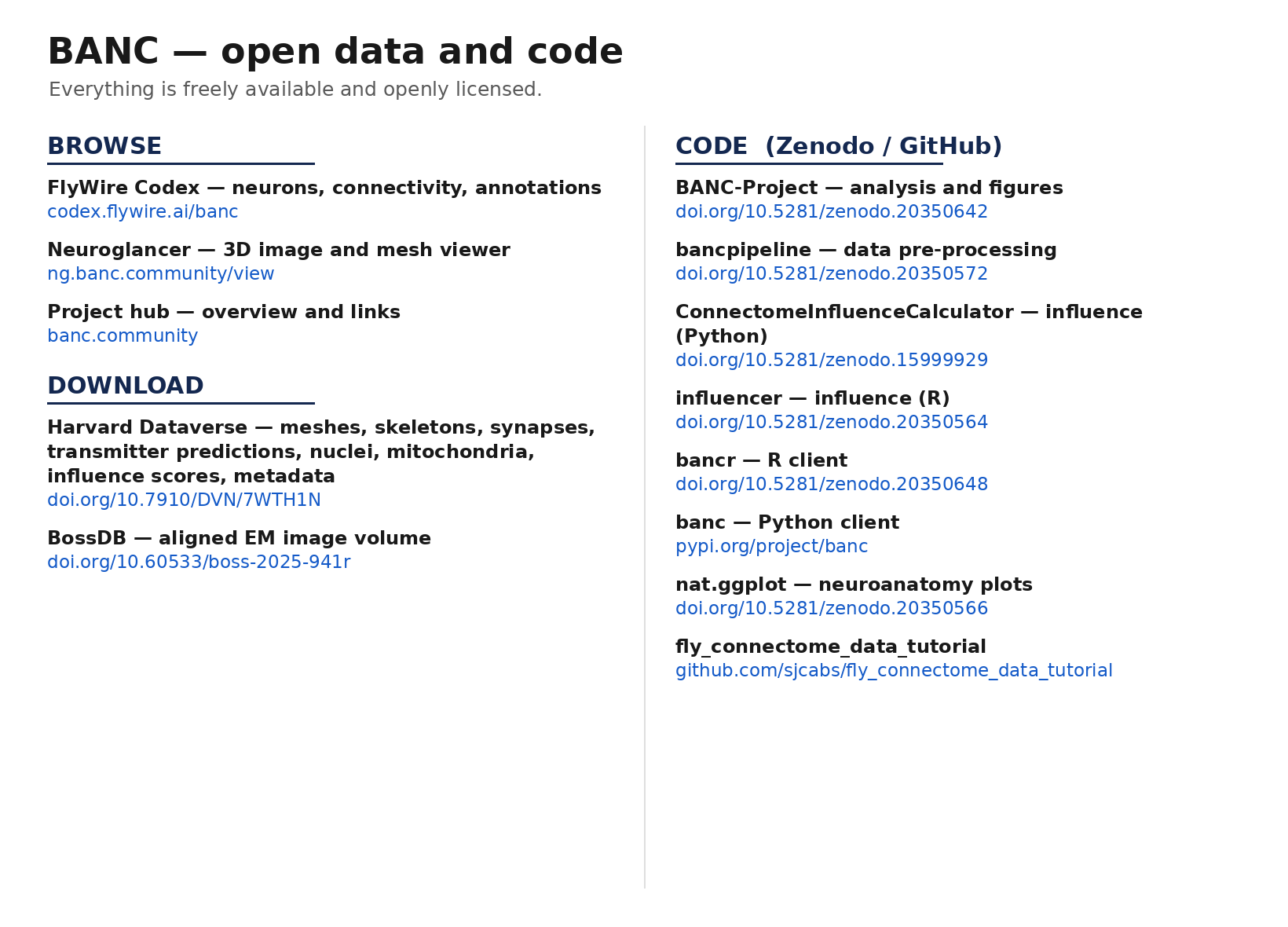
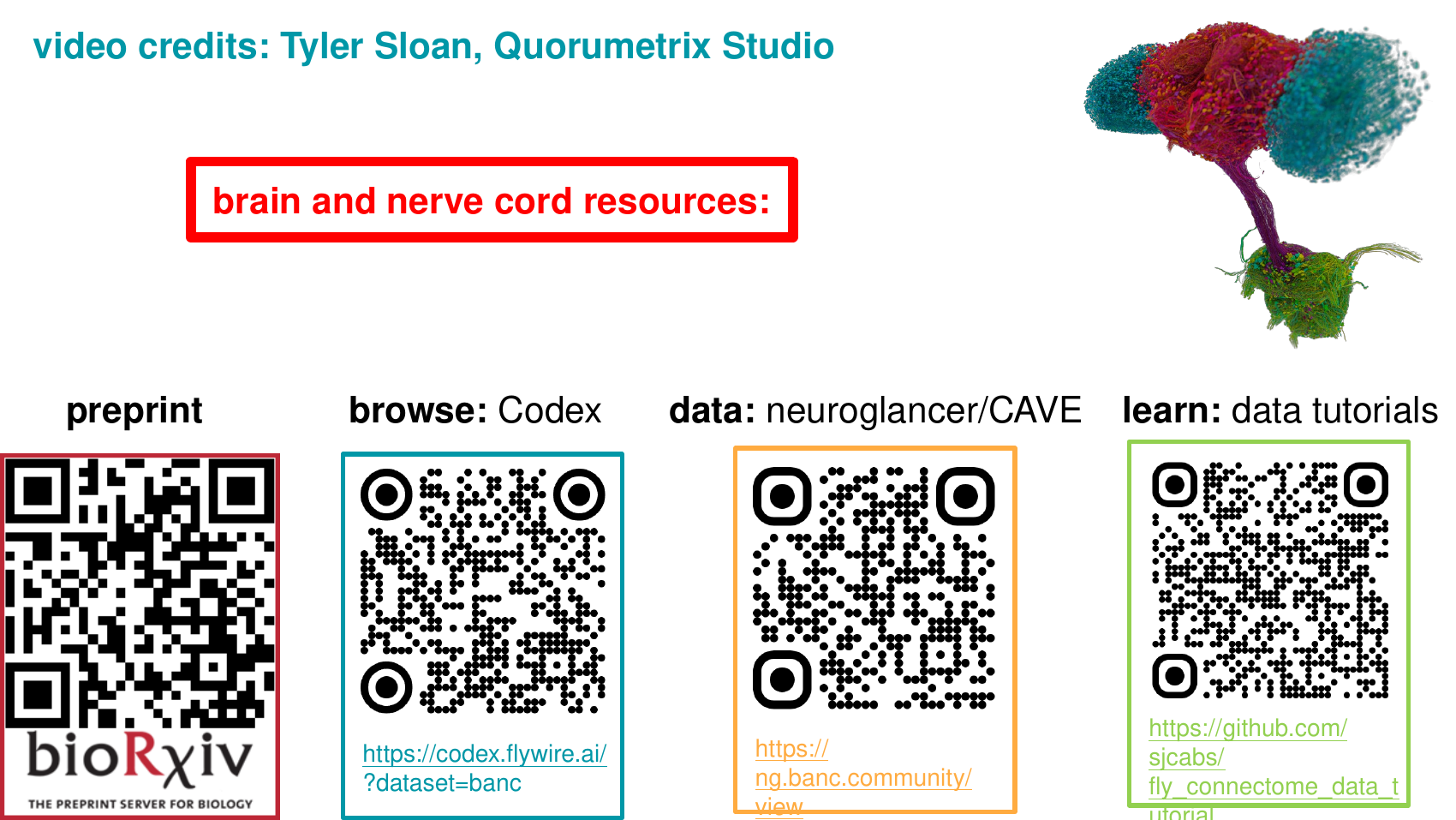
And very importantly, the BANC is a deep, open resource. Browse via FlyWire Codex and Neuroglancer; download everything from the Harvard Dataverse. For the full list of data and code locations, see Accessing the BANC data.
A contemporaneous male CNS
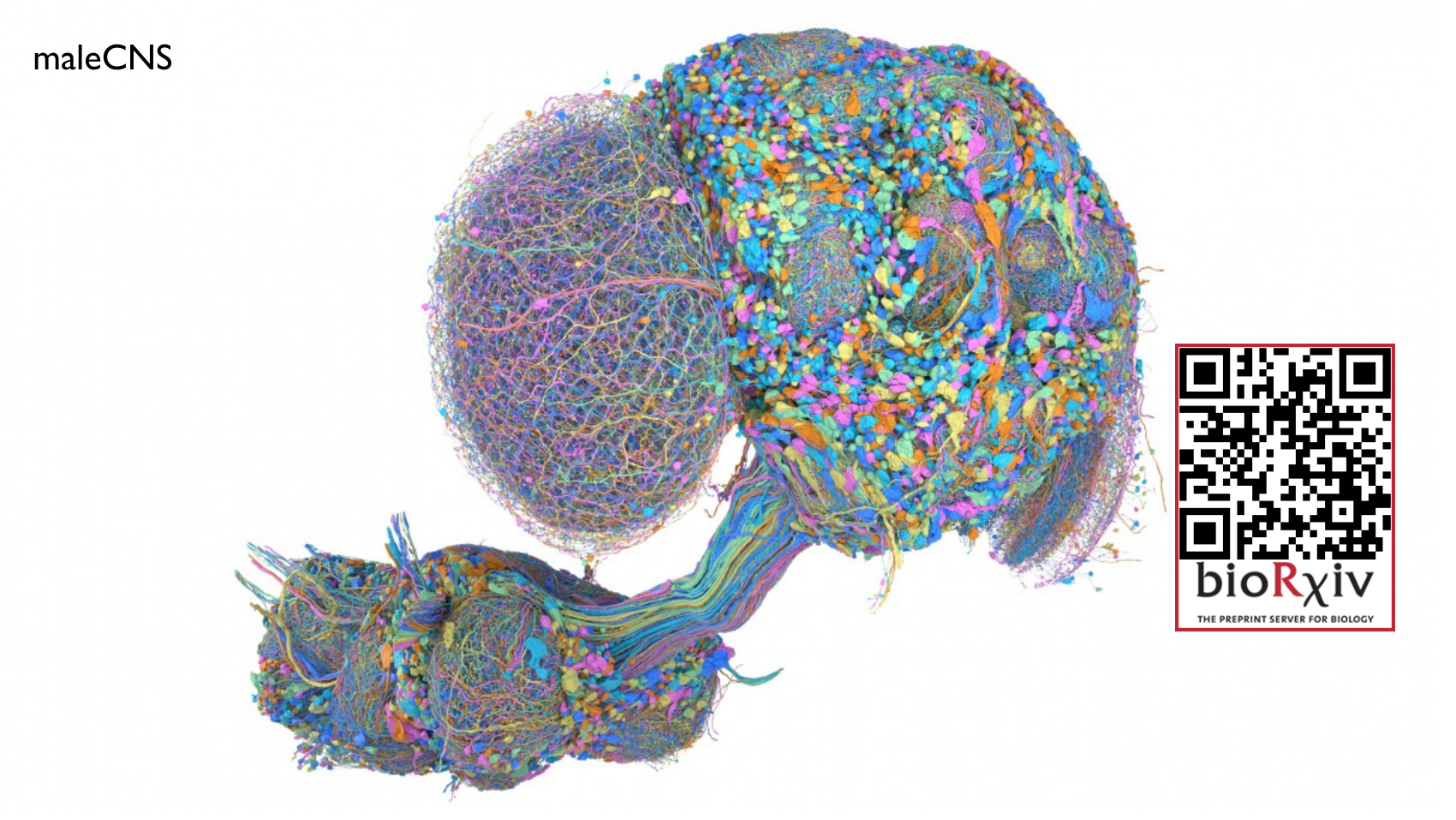
There is also a very high-quality, contemporaneous male CNS connectome, preprinted with data available at male-cns.janelia.org (Berg et al.). They compare the nervous systems of the sexes neuron by neuron.
Why it matters
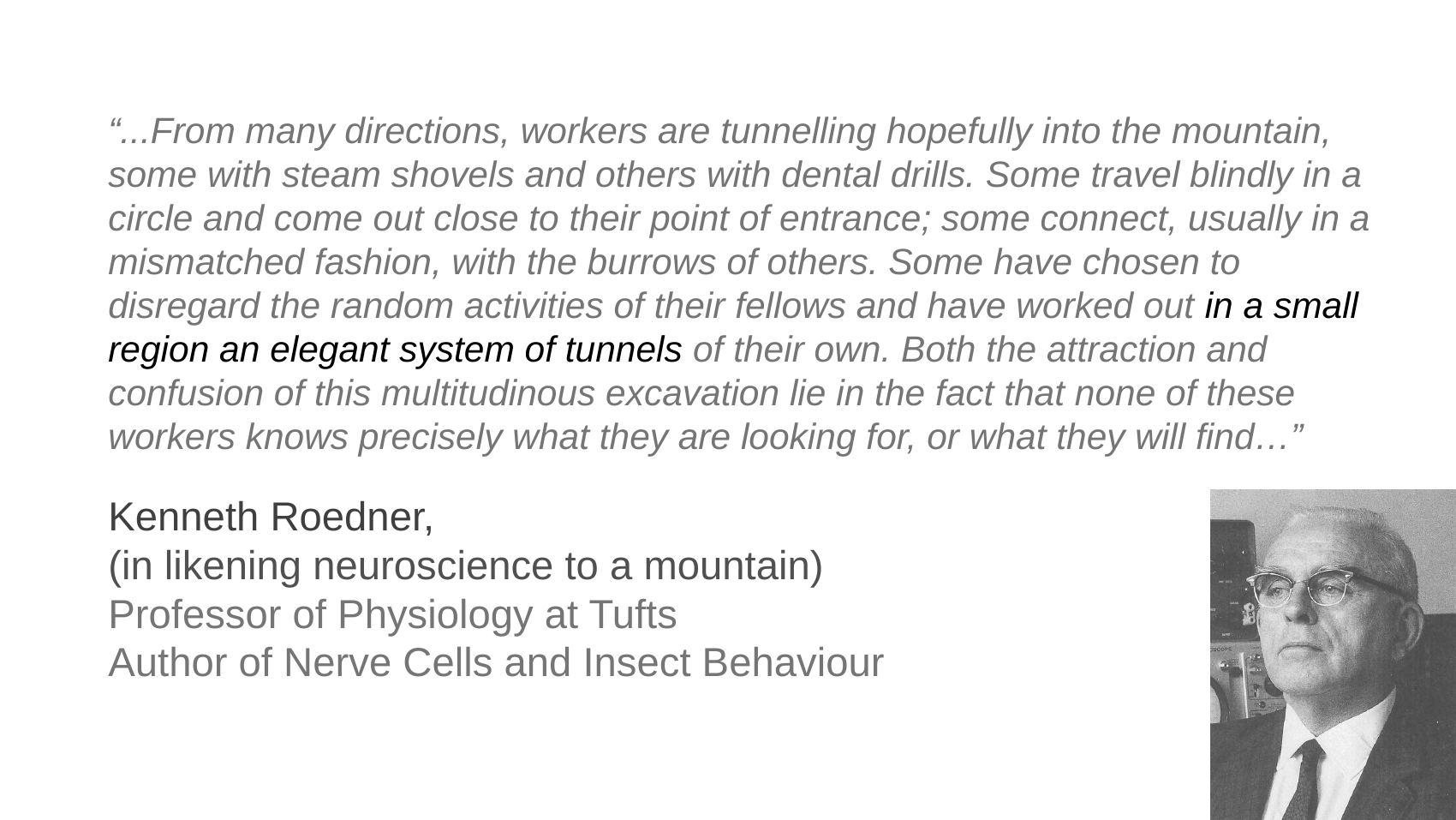
I think all this is a big deal. The fly connectomes give the field a strong organizational framework. I think they are making us an “organized system of tunnels”, and really advance the fly as the premier system for mechanistic, cognitive neuroscience.
A talk on the BANC
If you would like a deeper walkthrough, here is a talk I gave on the preprint version of the BANC.
Acknowledgements
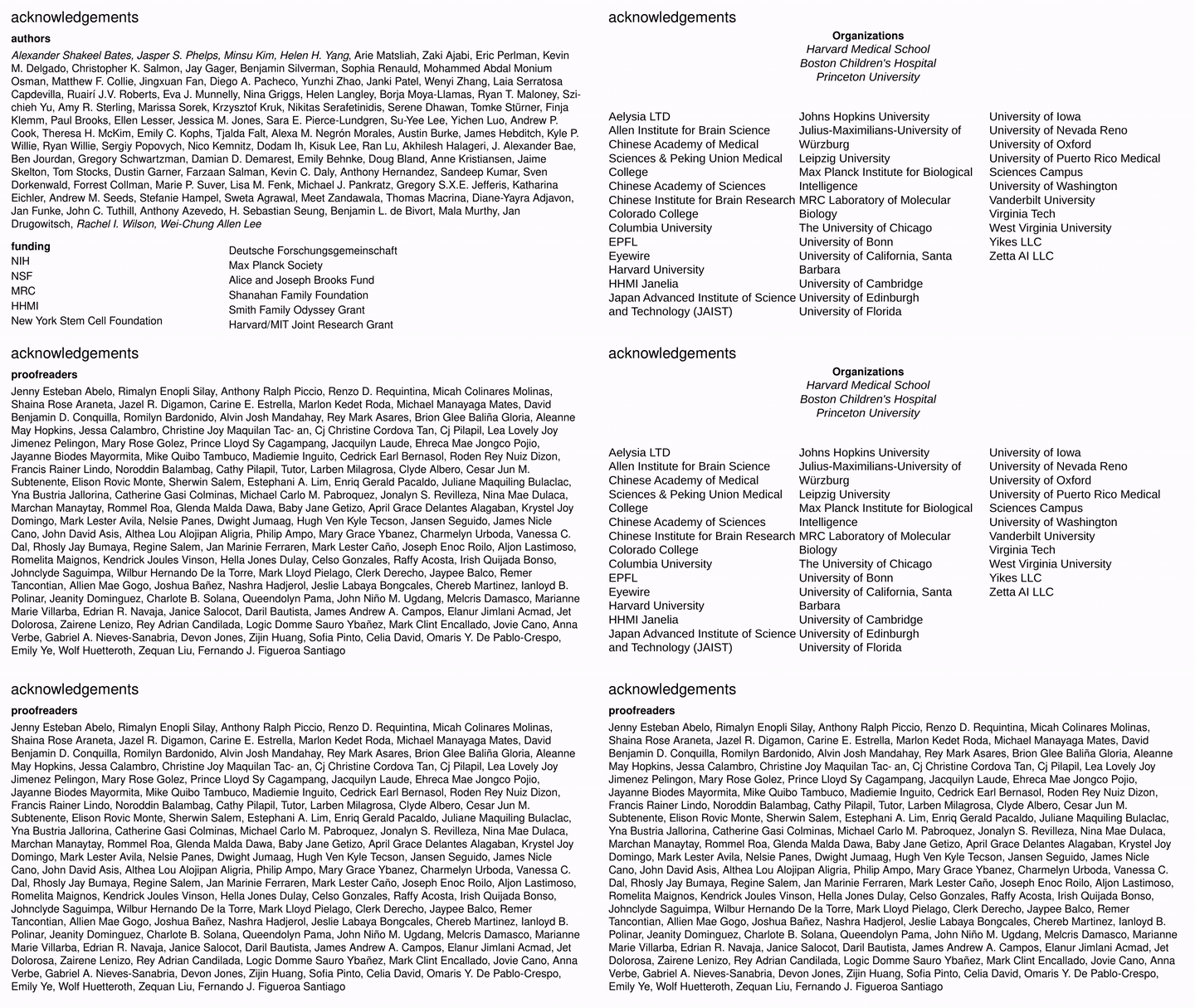
This was a big effort, led by Harvard Medical School with FlyWire based at Princeton. The BANC is the work of over 100 authors, the BANC-FlyWire Consortium of proofreaders and citizen scientists, and the SixEleven and Aelysia teams. Built especially with Minsu Kim, Jasper Phelps and Helen Yang, plus the groups of Mala Murthy, Jan Drugowitsch, Rachel Wilson and Wei-Chung Allen Lee. Funded by the NIH BRAIN Initiative, HHMI and Wellcome. Published with Nature.